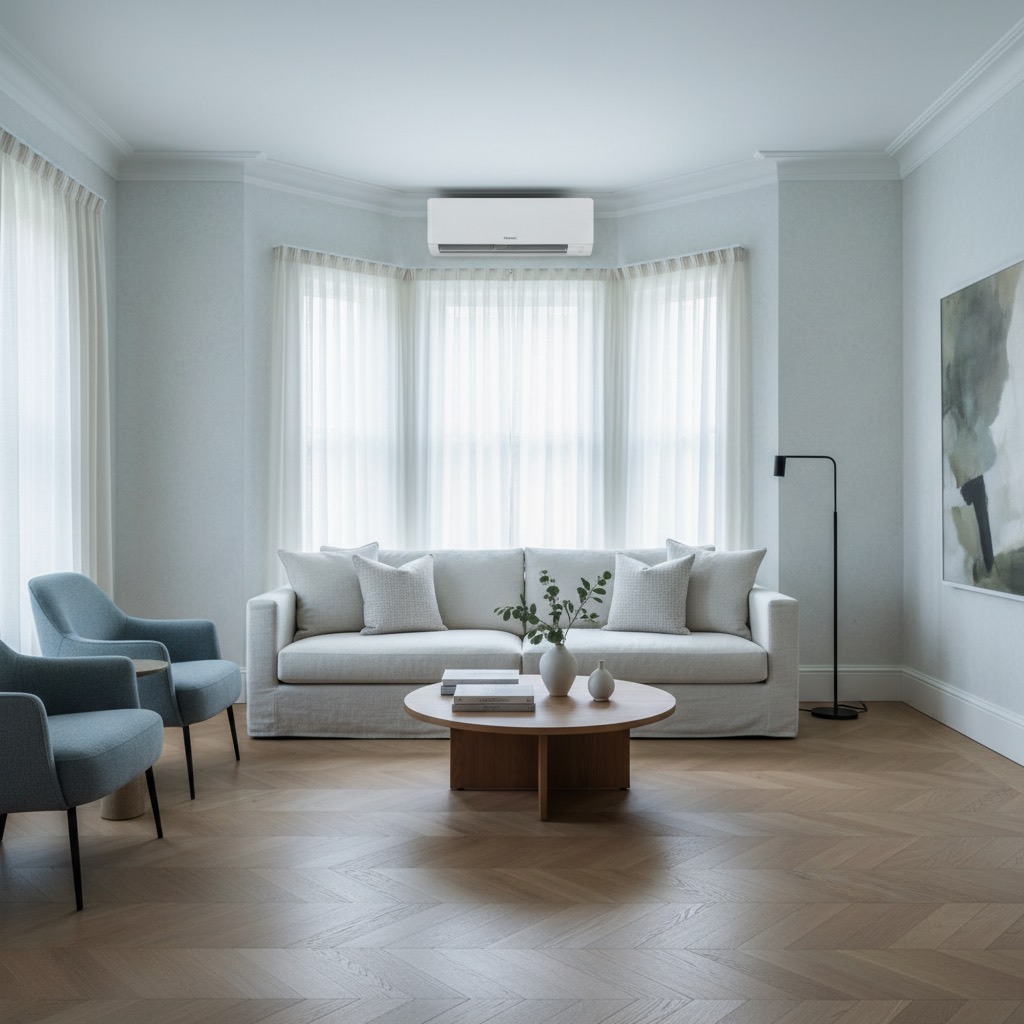
Why Gloucestershire homes overheat
Almost everything about the county's housing stock was designed to keep heat in. Cheltenham's Regency terraces have tall sash windows that turn south-facing upper rooms into greenhouses by mid-afternoon, and plenty of that stock has been split into flats, where warm air collects at the top of the building with nowhere to go. Gloucester's Victorian terraces have the familiar problems of solid walls and hot loft conversions, while newer estates on the edge of the city can be stuffy for the opposite reason — modern insulation holds on to summer heat as well as winter warmth.
Around Stroud and the Cotswold villages, thick stone walls buffer heat rather well — but once a stone cottage or converted mill has warmed through after a hot spell, it stays warm for days. If you're in a period property, our guide to air conditioning in older and Victorian homes covers the practicalities.
The useful thing to know is that a modern split system is a reversible air-to-air heat pump: it cools in summer and heats in winter, and does the heating efficiently, giving back several units of heat for each unit of electricity it uses. What it costs depends heavily on the property and how many rooms you want covered, so rather than quote figures here that may not match your home, we've set out realistic ranges in our guide to air conditioning costs in the UK.
Listed buildings, conservation areas and old wiring
This matters more in Gloucestershire than in most counties. Much of central Cheltenham — Montpellier, Pittville, the Suffolks — sits within conservation areas, and a good deal of the Regency stock is listed. Large parts of the wider county fall within the Cotswolds. None of that automatically rules out an outdoor unit, but placement needs checking with the council before anything goes on an external wall.
- Listed building or conservation area? Check with the local authority first, every time — a decent installer will help with this rather than wave it through.
- Flat or leasehold conversion? You'll almost always need the freeholder's consent for an outdoor unit.
- Older electrics? Regency and Victorian homes often need their wiring checked, and sometimes upgraded, before an install — get that confirmed before you commit to anything.
Where Coolhouse is up to in Gloucestershire
A straight answer: we're not live here yet. Our vetted installers are currently in Hertfordshire, and Gloucestershire is a county we want to reach, not one we already cover. If you ask for an estimate, we won't pretend otherwise — we'll give you a realistic picture for your home, tell you honestly where the network has got to, and get in touch the moment an installer we trust comes on board near Cheltenham, Gloucester or Stroud.